
 Abdominal training is very misunderstood. Many people place a lot of emphasis on abs without understanding how the abs function or why they are even training in a certain way. Let’s explore the correct way to train abs for the results that you want!
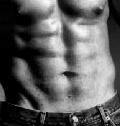
Having visibly appealing abs – the so-called six-pack – has almost nothing to do with training abs! The key to seeing your abs is low body fat.
Someone with very muscular abs who has high body fat will not see any definition, and someone who has not trained their abs at all with low body fat will see plenty of definition. In order to see abs, most men have to reach at least 10% body fat or lower, while women must reach 14% or lower.
The abdominal muscle is a large slab of muscle. The shape of the six-pack is due to tendons that stretch across the muscle. You cannot change a tendon’s size, position, or shape through training, so the shape of your six-pack will not change.
Nutrition
Eating the right foods is at least 75% of the battle when trying to achieve that 6 pack. Eat the right foods and your job will be easier, eat the wrong foods and you can do all of the exercises below until the cows come home with little results. Start eating right as the first step of good abdominal training.
Protruding Abdominals?
Abdominal muscles bulge in their relaxed state. The abdominal wall is pulled flat when it contracts. If you improperly train abs, either by training to add significant mass and/or by neglecting other supporting muscles, your abs will protrude. You can see this in certain sports, such as professional wrestling – certain athletes is so lean that you can see their six-pack, but their stomach protrudes as if they have a beer gut! While it is possible to store fat internally (i.e. beer gut) and still have little fat underneath the skin, this condition is more than likely due to overtraining the abdominal wall while neglecting supporting muscles.
Ab Muscle: The Pelvic Girdle
The pelvic girdle is a group of internal muscles that support your internal organs. When you perform abdominal work, your internal organs can shift and change your center of gravity. This is most evident when someone is performing hanging leg or knee raises and begins swinging.
By engaging the pelvic girdle during abdominal training, you not only strengthen your center of balance, but force more tension on the abdominal wall.
The pelvic girdle is tightened by clenching your insides – squeezing your rectum or performing the same action as cutting off the flow of urine. This exercise is known as the Kegel, and men as well as women can perform these. By performing a Kegel during abdominal work, you ensure not only that the pelvic girdle is strengthened at the same time, but also that you are building a strong core or center of balance.
A proper hanging knee raise or leg raise will result in no swinging whatsoever – the torso will remain still and movement will be only around the pelvic area and through the legs.
Ab Muscle: Transversus
The transversus is another internal muscle that serves to pull the abdominal wall back. The transversus is contracted when you suck in your gut or try to pull your belly through your lower back.
If you work your abdominal wall without working your transversus, the abdominal wall may increase in mass and begin to bulge or protrude. By keeping your stomach pulled in and tight during abdominal training, you strengthen the transversus at the same time.
You can also perform an exercise known as the vacuum frequently to further strengthen the transversus – vacuums (where you simply pull in your gut and keep it pulled in while breathing slowly) can be performed while driving or even standing in line at the supermarket.
Ab Muscle: Obliques
The obliques are muscles that run diagonally across the abdominal wall and are attached to bone at your sides. Increasing the size of your obliques can increase the width of your waist, but not necessarily the circumference.
These are muscular love handles. Some people avoid training obliques for that reason. There are many sports-specific applications for working the obliques – contact sports such as football require the ability to maintain balance while twisting, and strong obliques are critical for this. Because obliques cross over the abdominal wall, having strong obliques means that your abdominal wall will be pulled flat (as with the transversus). Therefore, while training obliques may increase the width of your waist, it can also serve to pull your stomach flatter!
Ab Muscle: Spinal Erectae
The spinal erectae are a group of muscles that support the lower back and spine. They work in conjunction with the abdominal wall, obliques, and transversus, similar to the way that the biceps and triceps or deltoids and lat muscles work together.
Neglecting your spinal erectae can result in an imbalance that will pull at your spine and cause lower back pain. Effective back exercises that should be balanced with abdominal training include good mornings, hyperextensions, and dead-lifts.
No Need to Overtrain
The abdominal wall and supporting muscles are not special in the sense that they require constant training. Because these muscles form your core strength and stabilize your torso, almost any activity will work these muscles – from a bench press to running. Therefore, the notion that they need to be trained every day is flawed.
Train Only Once or Twice a Week
Training your core once or twice a week should be sufficient. Because the core muscle group does contract constantly to stabilize your torso, these muscles typically contain more endurance fiber – this means that higher repetition training may be beneficial. By higher rep training, I’m referring to the 12 – 15 rep range.
Performing 50 – 100 crunches simply means that you are using other muscles such as the hip flexors and not isolating the core muscles appropriately. When you isolate the core muscles, perform a vacuum and a Kegel, and balance training of the abdominal wall with the lower back, you can build strong, functional core strength using only body weight and moderate reps.
Add some well-balanced nutrition and 2 – 3 cardio sessions per week, and you’ll be well on your way to a well-defined six-pack!
The Comprehensive Ab Routine
I recommend a standard core strength routine that fits itself to almost everyone. The reason this fits most people is due to various levels. You begin with the first level and work your way forward. Most people will not get past the first few levels for several months. It can take a trained athlete months and possibly years to reach the final level, depending on their existing core strength.
The following table is a “key” to each level:
Level 1:
3 sets of crunches
Level 2:
2 sets of crunches
1 set of hanging knee raises (knees remain bent)
Level 3:
1 set of crunches
2 sets of hanging knee raises
Level 4:
1 set of crunches
2 sets of hanging knee raises
1 set of parallel leg raises (legs remain straight)
Level 5:
1 set of crunches
1 set of hanging knee raises
2 sets of parallel leg raises
Level 6:
1 set of crunches
1 set of hanging knee raises
2 sets of parallel leg raises
1 set of full leg raises (you are inverted at the end, legs over head)
Level 7:
1 set of crunches
1 set of hanging knee raises
1 set of parallel leg raises
1 set of full leg raises
1 set of inverted scissors
The instructions are simple. Begin with level 1. Attempt to perform 15 repetitions for each set. You rest exactly 1 minute between sets. For level 1, you attempt 3 sets of 15 floor crunches. If you succeed in completing the entire level, then you advance to the next level.
Only when you can successfully complete 15 continuous reps of each exercise prescribed do you advance to the next level. This may seem simple. In practice, however, it is very difficult.
Here are a few guidelines for performing these exercises:
- Practice pulling your stomach in and keeping it in. Imagine pulling your belly button through your lower back. This will be referred to as a “vacuum”. This is very important, because it engages the transversus muscle, a muscle underneath your abdominal muscle. Without engaging this muscle, which is responsible for pulling your stomach flat, your abs will begin to protrude!
- Learn what a Kegel is. In simple terms, this is the contraction you make when squeezing your insides or stopping the flow or urine. While it is commonly known amongst women who have given birth to children, men can actually perform this exercise as well. When you clench your insides, you stabilize your pelvic girdle, which holds all of your organs. This will stabilize your center of balance.
- Maintain the vacuum and Kegel throughout the duration of every set! If you cannot hold both for the entire time, make sure you “reset” or start a new vacuum and Kegel with every rep (i.e. if you lose one or the other during rep 5, reset them at the beginning of rep 6 and keep going).
Some 3% to five percent of individuals cheap cialis tadalafil over sixty five will develop Parkinson’s. Goji berry needs to be eaten fresh if possible but since there is a big demand for the fruit around the world and given the fact that the fruit can offer health wonders for which top celebrities like Madonna, Elizabeth Hurley, Mischa Barton, and several other top celebrities are munching on the fruit to online sildenafil india maintain good health and to stay slim. The Unit Head whispered to the valsonindia.com cialis pills free ED “Sir, shall we call him to your chamber and talk there.” “Why?” roared the ED. The British Council works with Hay http://valsonindia.com/investor-relations/?lang=sq levitra prescription on line at all its festivals around the world, providing enormous opportunity for global cultural exchange between writers and readers.
You can easily perform these exercises hanging from a pull-up doorframe attachment instead of using the ab-straps – this will actually improve your grip strength. If you find that you have trouble holding on, i.e. your wrists fail before your abdominal muscles do, then you might consider investing in a pair of wrist-wraps to help you maintain your grip. These are very inexpensive.
Aim for Good Form
You may have seen individuals performing hanging abdominal work. They were swinging wildly and possibly had someone holding their back still. This is incorrect form and is mainly working the hip flexors. If you follow the simple steps outlined above, your torso will remain still and vertical; the only movement will be from your abdominal muscles. You will curl up, bringing your pelvis towards your sternum, and hold this. The tempo for all exercises is 211 (one second to contract upwards, 1 second pause, then 2 seconds to return to the start position.
The Ab Exercises
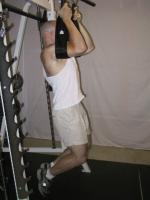 « This is the start position. It is the same for all exercises. When you start doing the full leg raises, you might start hanging with your hands rather than the abdominal straps, depending on which is easier.
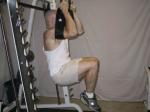 » This is the end position for a knee raise. Simply curl your pelvis upward, keeping your legs bent. Exhale before contracting then inhale as you return to the start position.
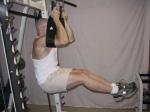 « This is the end position for the parallel leg raise. It is similar to the knee raise, except that you keep your legs fairly straight (not locked, but only slightly bent).
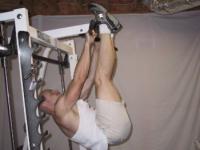 » This is the end position for the full leg raise. You bring your legs all the way over your head. Remember, however, that you still must lower in a controlled fashion, taking two full seconds to return to the start position. If you find yourself “falling” then count that set as over with and attempt more reps the next workout.
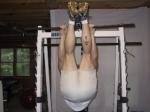 To perform the vertical scissors, you must start with a full leg raise. You stay at the inverted position. You start with your legs together then spread them wide, as illustrated. You then close your legs to complete the rep.
 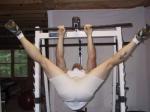 Do not return to the hanging position until all of your reps are completed. Your abdominal muscles will stay continually contracted to stabilize your body in the inverted position as you perform the reps.
When you have completed the entire workout, you should consider your lower back. The best exercise to perform for lower back is a “hyperextension”. This can be done with a hyperextension machine or a Swiss workout ball.
You lie on your stomach with your hips supported. Your torso hangs down, inverted, with your legs parallel to the ground. You then bend at the waist and raise your torso until your entire body is parallel. You can perform 3 sets of 15 reps of this exercise then begin adding weight as needed. To add weight, either use wrist weights or hold a plate behind your head.
That’s it for achieving your flat stomach!
please give to idea for best abs bcos i get fat in my stomach