
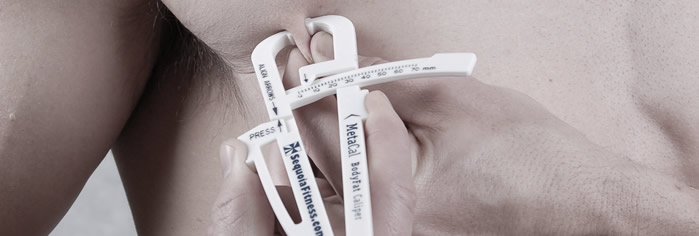
 This body fat percentage calculator will allow you to learn how to take your body fat measurements – 3-site and 4-site methods.
Measuring Instructions
Method 1:
Measure skinfolds at the Abdomen, Suprailiac, Triceps, and Thigh
Method 2:
- Take only 3 measurements.
- Men – Chest, Abdomen, Thigh.
- Women – Triceps, Abdomen, Suprailiac
Stand relaxed with your arms hanging comfortably by your sides – do not flex! When taking the thigh measurement, shift your weight to the leg that you are not measuring.
If you do not have calipers: You can buy a set of digital calipers from Amazon.com.
Skinfolds can be taken using 3 or 4 sites on your body – both methods are similar in accuracy.
BFP Calculator
More Calculators
- Fat Free Mass Index
- One Rep Max Calculator
- Zig Zag Calories Weight Loss
- Calories Burned
- BMR Calculator
Understanding Lean Mass
The difference between your weight and the total amount of stored fat is your “lean mass”. Many people mistake this for muscle – it is not. It includes muscle, but also includes bone, tissue, water, organs, even the contents of your stomach.
Just because your “lean mass” goes down doesn’t mean you lost muscle. You might have lost water. Just because your “lean mass” goes up doesn’t mean you gained muscle. You might have started to retain water. Again, use only as a guide – in general, your body fat should decrease over time until it stabilizes at a level that you are comfortable with.
Increasing the Body Fat Percentage Accuracy
Whoever administers the test should test each site in round robin fashion at least twice. In other words, one pinch on your abdomen isn’t enough. They should pinch your abdomen, then other areas, then return to the abdomen for a second pinch. If the results vary greatly, they should take additional measurements to narrow down the precision of the answer.
I prefer the calipers over other methods for testing body fat, when your Body Mass Index indicates that you are not in the obese range. The majority of equations for body fat percentage were not computed from obese or heavier people, and therefore they can be wildly inaccurate.
The Health Impact
Body fat percentage is sometimes used as an estimate of how healthy or fit you are. With obesity on the rise and recent changes with the health care reform tax credit, many are seeking to shed excess weight and furthermore, keep it off. Statistically, someone with a lower body fat than someone else is probably more fit. This is not always true, however.
A person with an extremely fast metabolism who eats junk food all day long may maintain a low body fat, but make no mistake: they are less healthy than someone with a higher body fat who eats healthy foods and exercises.
Measure Body Fat Consistently
Perform the test yourself, or have someone else do it. If you have different people perform the test, even trained professionals, the results may vary widely. The key with body fat percentage is to remember that it is just another number – a statistic – to help you gauge your progress, it is not the “end all”.
Someone who looks great and feels good but has a higher body fat has no reason to drop any lower. Someone who appears to have extremely low body fat based on measurements but looks overweight and feels terrible should probably consider dropping weight. One specific percentage doesn’t mean the same thing for everyone or even every age.
When To Use The Scales
There are many different ways to measure body fat. Operator error can make the measurement inaccurate and ruin any precision. If you are interested in seeing what various body fat percentages look like, check out the Body Fat Percentage Guide for Men.
It is common for obese individuals to assume they have more muscle on their body due to an inaccurate body fat measurement. I use the scale as the primary tool until you are in the overweight range (but not obese) on BMI, and then start to use the calipers for body fat. While other methods, such as body fat scales and hand-held devices are useful for measuring trends, they tend not to be as accurate or consistent as calipers.
Thanks George, we’ll fix it up.
The calculator does still not work.
Try inputting your numbers and then wildly fluctuating the chest measurement. There’s no change in the bf percentage, meaning something in the formula isn’t factoring that measurement in.
@Michael That’s because you are only to put in three measurements.. if you put in five in doesn’t factor in the chest measurement. Men are to put in chest, abs and thigh..
Thanks for your post. My partner and i have usually noticed that the majority of people are eager to lose weight since they wish to appear slim in addition to looking attractive. On the other hand, they do not always realize that there are more benefits for you to losing weight in addition. Doctors insist that obese people have problems with a variety of health conditions that can be directly attributed to their excess weight. The great news is that people who definitely are overweight along with suffering from different diseases can help to eliminate the severity of their illnesses by way of losing weight. It is easy to see a gradual but notable improvement in health whenever even a minor amount of fat loss is accomplished.
One thing I’d prefer to touch upon is that weight loss program fast can be achieved by the suitable diet and exercise. A person’s size not merely affects the look, but also the quality of life. Self-esteem, melancholy, health risks, as well as physical skills are disturbed in an increase in weight. It is possible to just make everything right and still gain. Should this happen, a condition may be the root cause. While an excessive amount of food and never enough body exercise are usually accountable, common medical conditions and traditionally used prescriptions may greatly enhance size. Thx for your post here.
I discovered more interesting things on this weight reduction issue. 1 issue is that good nutrition is vital while dieting. An enormous reduction in bad foods, sugary food, fried foods, sweet foods, beef, and white colored flour products can be necessary. Having wastes unwanted organisms, and harmful toxins may prevent goals for losing belly fat. While specific drugs in the short term solve the matter, the horrible side effects are certainly not worth it, and they never give more than a short lived solution. This can be a known fact that 95% of celebrity diets fail. Many thanks for sharing your thinking on this blog site.
Thanks for the points shared on your own blog. Another thing I would like to talk about is that weight reduction is not exactly about going on a fad diet and trying to lose as much weight as you’re able in a few days. The most effective way to lose weight is by acquiring it bit by bit and obeying some basic ideas which can allow you to make the most from a attempt to lose weight. You may be aware and be following some tips, nevertheless reinforcing understanding never hurts.
I believe avoiding refined foods could be the first step so that you can lose weight. They can taste great, but prepared foods have very little nutritional value, making you try to eat more simply to have enough power to get with the day. If you’re constantly ingesting these foods, transitioning to cereals and other complex carbohydrates will help you have more electricity while ingesting less. Interesting blog post.
This body fat calculator is awesome. I was previously using a method that calculated the % body fat using only the suprailiac fold. I was getting a result of 16 – 17%. With your calculator my result is 13.9%. Measuring at more than one location I feel gives more accurate results. Thanks.
i am an extremely active person and i watch my diet like a hawk. my girlfriend says i count calories like a girl. my body fat is at 8.07 i am 6,5 and weigh 210. i am by no means built like a runner and was wondering what yall think a good BFP is. i can not get a definitive answer. most places say 10% others say 7% min and where as some tell me 2%-5%. just looking for yalls opinion. great calculator by the way thank you.
Hi Frank, I would say you’re in a great place.. Most body builders and fitness models never hold 5% or below for long.. It’s just not healthy nor natural in my opinion.
I’m looking for a weight loss product that will really help me lose weight. Im not looking to spend heaps of money on some dodgey product that doesnt work.
We recommend Tom Vanuto’s burn the fat . Not Expensive and it works or your money back.